
Decor trends renew every season, but the choices that truly transform an interior rely less on fashion effects and more on concrete decisions: which materials to prioritize, how to adapt a living room to a small space, and what color palettes manufacturers are offering this year. Understanding these axes allows for the construction of a coherent decoration project, grounded in longevity rather than the ephemeral.
Connected decorative lighting and mirrors: technology that fades into the background
The segment of decorative objects incorporating a technological dimension is notably progressing in the B2B catalogs for 2025-2026. Lighting and mirrors that feature LEDs, or even Bluetooth connectivity controlled by an app, are no longer presented as technical equipment. They now appear in the decoration aisles, alongside vases and frames.
This shift changes the perspective when furnishing a room. A wall mirror with integrated lighting replaces both a wall sconce and a decorative element, freeing up wall space and simplifying wiring. For small urban spaces, this gain is significant.
Field feedback varies on the durability of these products. An entry-level connected decorative light may see its Bluetooth module become obsolete in a few years, whereas a classic lampshade raises no compatibility issues. Before investing, it’s wise to check if the manufacturer offers firmware updates or a degraded operation (manual lighting) in case of a connected module failure.
It is on these types of criteria that it becomes useful to rely on the decorative expertise at Place A to identify pieces whose design goes beyond mere showcase effect.
Modular furniture and small spaces: beyond the convertible sofa
Modularity has become a major purchasing criterion in 2025, particularly in urban contexts. Recent analyses of living room decor trends highlight modular sofas, extendable tables, and storage solutions that can be reconfigured according to use. The principle is simple: the same piece of furniture should serve multiple functions without cluttering the room when not in use.
The challenge arises when trying to combine modularity with material quality. A reconfigurable sofa module made of technical fabric withstands frequent handling better than a model in natural linen, whose fibers wear out more quickly at friction points. The choice of covering affects the longevity of the furniture as much as its aesthetics.
Criteria to check before buying modular furniture
- The density of the seat and the quality of the internal structure (solid wood or particleboard), which determine durability after dozens of reconfigurations
- The assembly system of the modules: metal clips, magnets, or simple Velcro, each solution implies a different level of stability
- The availability of additional modules sold individually, to expand the set if your space evolves without needing to buy a complete sofa
- The compatibility of covers with machine washing, a often overlooked point that affects maintenance over several years
A poorly designed modular piece of furniture ends up being used in only one configuration. The initial investment then loses all its meaning.
2025 Color Palettes: What Industrial Color Charts Reveal
Paint manufacturers publish thematic collections each year that guide the choices of decorators and individuals. For 2025, the color charts from Tollens and Colour Hive converge towards specific directions: warm browns, natural greens, and acidic pastels take center stage. Pink, in particular, is positioned as a new neutral, capable of replacing beige or light gray on large wall surfaces.

This orientation contrasts with the minimalist palettes that dominated previous years. The proposed shades require more mastery in combinations. A sage green works well with light wood and linen but becomes heavy against dark furniture or a dark gray polished concrete floor.
Combining new shades without upsetting a room
The most reliable rule remains to limit the palette to three tones per room: one dominant (walls), one secondary (main furniture), and one accent (textiles, decorative objects). Acidic pastels, like lemon yellow or mint green, work better as accents than as dominants. Applied to four walls, they tire the eye within weeks.
Warm brown replaces gray as a versatile neutral base. It pairs well with natural materials (wood, rattan, terracotta) and absorbs artificial light well, making it suitable for north-facing rooms or dimly lit interiors.
Natural materials and artisanal lines: what lasts versus what fades
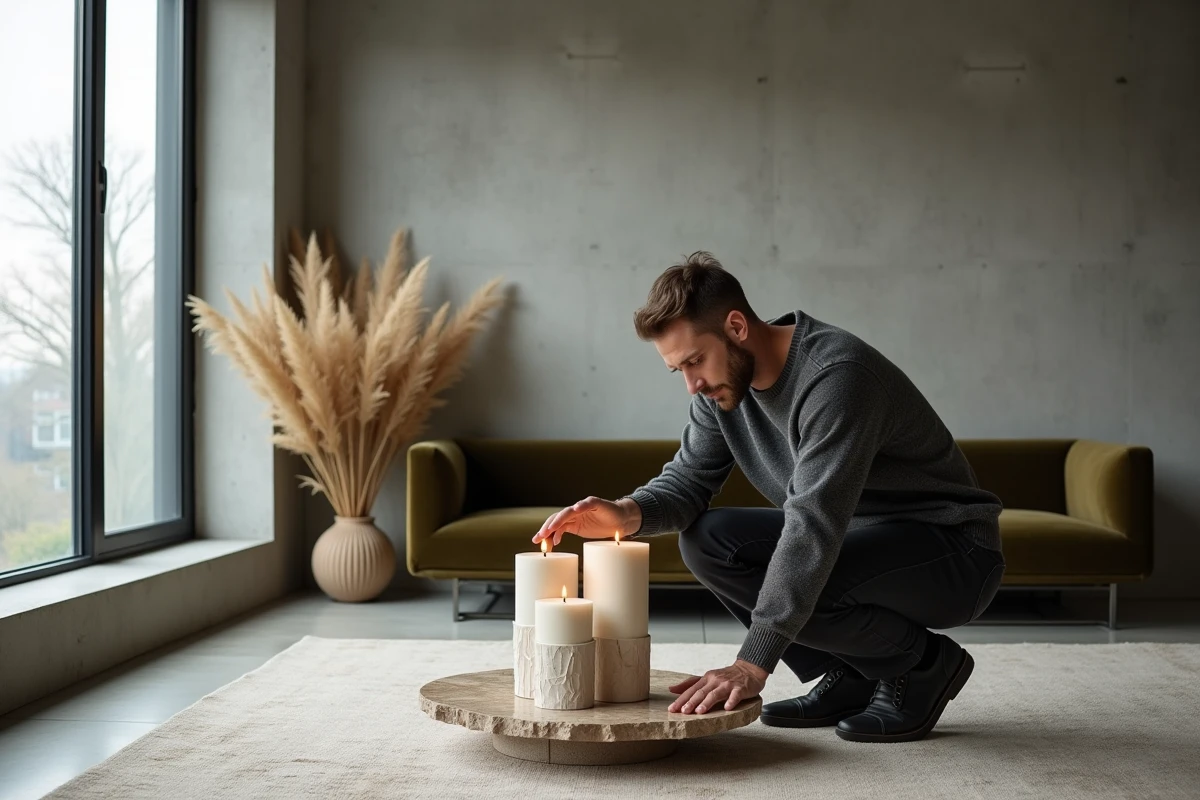
Wood, stone, and terracotta remain reliable values in interior decoration projects. Their presence in the 2025 trends is nothing new, but their treatment is evolving. Raw finishes, intentionally imperfect, are gaining ground against smooth and uniform surfaces. A table top made of oak with visible knots or terracotta tiles with irregular edges reflect this quest for authenticity.
- Unfinished solid wood provides a lively texture that evolves over time but requires regular maintenance (oil, wax) to avoid stains
- Natural stone (travertine, veined marble) offers a unique appearance for each piece, but its weight imposes installation and support constraints
- Textiles made from natural fibers (linen, thick cotton, jute) complement these materials without creating visual breaks, provided they remain dense enough for daily use
The appeal of artisanal lines also raises a budget question. A handmade decorative object costs significantly more than an industrial equivalent, and the difference is not always perceptible to the eye in a furnished room. The decision depends on the place the object occupies in the space: a handmade vase on a shelf among ten other objects is less noticeable than a hand-turned ceramic pendant, alone in the center of a room.
Building an interior that reflects a personal style requires crossing these different axes (colors, materials, modularity, lighting) without stacking them. A successful decor project relies on three or four strong choices, not on the accumulation of all current trends. The rest follows naturally.