
Linalool and linalyl acetate, two monoterpenes found in varying concentrations depending on the chemotypes of Lavandula, act directly on the olfactory receptors of arthropods. Understanding which insects are truly repelled by lavender requires going beyond general statements to examine the neurobiological mechanisms at play and the actual limits of this repulsion.
Linalool and linalyl acetate: mechanism of olfactory disruption in dipterans
Lavender does not indiscriminately repel “insects.” Linalool disrupts the chemical detection of hosts in certain biting dipterans but has no notable effect on pollinating hymenopterans. This selectivity can be explained by the structure of the olfactory receptors (OR) specific to each family of insects.
A study published in 2023 in Insects (Abdel-Ghaffar et al.) shows that formulations based on Lavandula angustifolia modify host-seeking behavior in Aedes aegypti and Culex pipiens. Approaches towards treated areas decrease significantly for several tens of minutes.
The duration of repulsion remains limited. Volatile compounds dissipate, and protection decreases rapidly outdoors, especially in hot and windy weather. A lavender plant on a terrace does not create a permanent “mosquito-free bubble.”
To delve deeper into the subject, a comprehensive overview on insects repelled by lavender also details mammals sensitive to these compounds.
Lavender and pollinators: a nectar plant that attracts as much as it repels
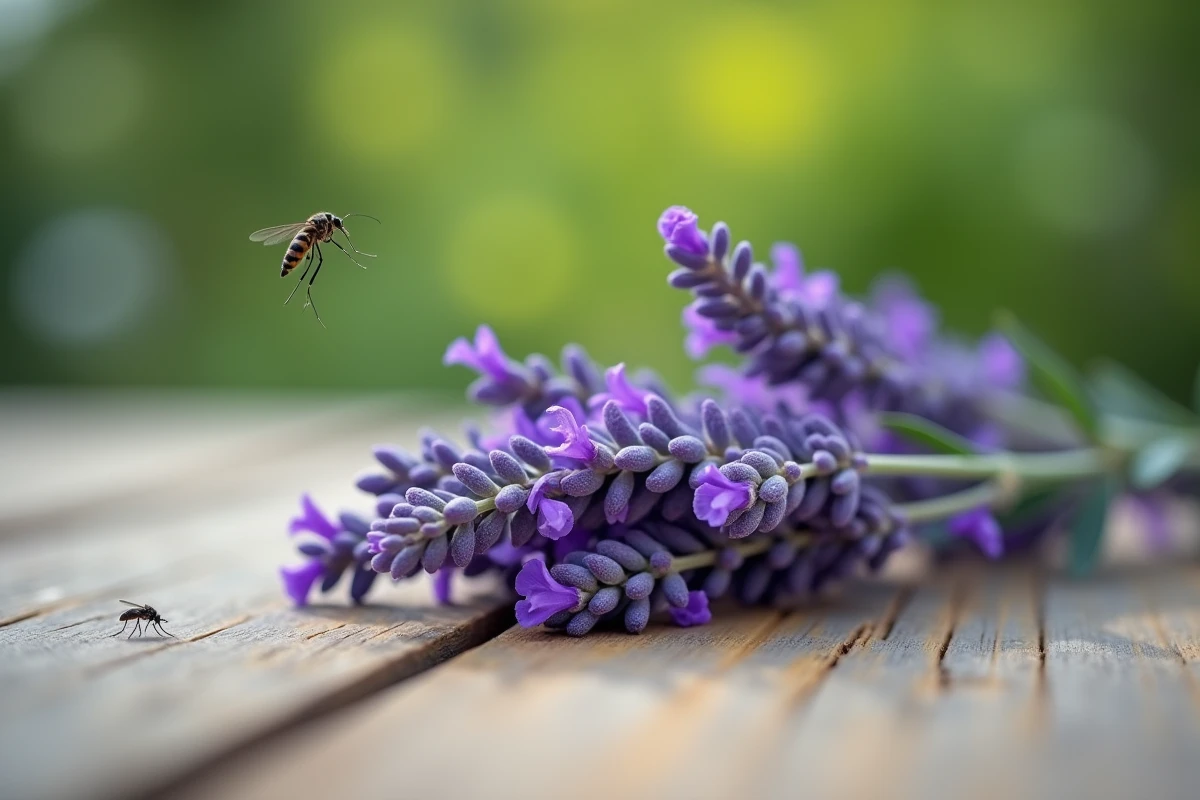
Data from the SPIPOLL program of the Muséum national d’Histoire naturelle (2022 synthesis) confirm that ornamental lavenders in urban environments regularly attract wild bees, hoverflies, and butterflies. Mosquitoes remain rare. Thus, lavender acts as a selective filter rather than a universal repellent.
This distinction has practical implications for the garden. Planting lavender near a vegetable garden promotes pollination without increasing the pressure from harmful dipterans. Relying on it as the sole mosquito barrier for a terrace is an unrealistic expectation.
Attracted species vs. repelled species
- Attracted: domestic and wild bees, bumblebees, hoverflies, daytime butterflies, certain flower beetles. These species do not possess the same olfactory receptors as biting dipterans.
- Repelled or disturbed: mosquitoes (Aedes, Culex), some houseflies, textile moths. Linalool interferes with their ability to locate a host or food source.
- Variable effect: ants and wasps show inconsistent reactions depending on the concentration of essential oil and environmental conditions. Field reports are contradictory, and no solid published data decisively favors one side or the other.
Lavender chemotypes and repellent effectiveness: not all lavenders are equal
Lavandula angustifolia (true lavender), Lavandula latifolia (spike lavender), and lavandin (Lavandula x intermedia) have distinct biochemical profiles. The linalool content varies significantly from one species to another and from one terroir to another.
Spike lavender contains more camphor and 1,8-cineole than true lavender, giving it a more pronounced repellent power against flies. Lavandin, a sterile hybrid, produces a higher volume of essential oil per plant, but with a less refined aromatic profile. For repellent use in the garden or on the terrace, lavandin offers better olfactory yield per linear meter.
Checking the exact chemotype before purchase remains useful, especially for essential oil. A true lavender oil rich in linalyl acetate will have a marked calming effect but a lower repellent power compared to a spike oil dominated by camphor.
Essential oil, sachets, or fresh plant: which form to choose
Diffused essential oil offers the highest concentration of active compounds. A few drops on a porous support (fabric, ceramic) maintain a scent perceptible to insects for several hours indoors. Outdoors, the dissipation is too rapid to guarantee a lasting effect.
Sachets of dried flowers remain effective against textile moths in a closed space (wardrobe, drawer). Dried lavender loses its repellent properties within a few months: sachets need to be renewed or lightly crushed to release residual oils.
A living plant on the terrace contributes to the olfactory ambiance, but the volume of compounds it passively releases remains low compared to active diffusion. Crushing the flowers between fingers and placing them on the table temporarily amplifies the effect.

Repellent claims and European regulatory framework
The European regulation on biocidal products now governs the commercial claims of lavender-based products. A manufacturer can no longer label a spray as “lavender mosquito repellent” without submitting their product for evaluation in accordance with the guidelines of the European Chemicals Agency (ECHA).
This constraint explains why most gardening products limit themselves to the mention “ambient fragrance” or “well-being.” Any unvalidated repellent claim exposes the manufacturer to sanctions. For the consumer, this means that sprays sold as “natural lavender repellents” without a biocide authorization number have not demonstrated their effectiveness according to European standards.
This regulatory framework does not call into question the properties of linalool, but it imposes a level of proof that few artisanal formulations meet.
Lavender remains a complementary tool in managing pests in the garden and indoors, provided the right chemotype and application form are chosen and one does not expect protection comparable to an approved synthetic repellent. Its true asset lies in its dual function: attracting pollinators while disrupting biting dipterans, a balance that few aromatic plants offer with such reliability.